Tell it what matters. It shows you where to look.
Four modes, one framework underneath, and the same outputs whichever mode you choose.
Many claims environments. One platform.
TPAs, MGAs, cedants and in-house teams each run their own claims systems. The Audit Portal reads them natively: loss runs, bordereaux, file exports or a direct integration come in as they are. Each review runs on the framework and scoring you choose for what you’re reviewing, and every result builds a history you can analyze across audit periods, organizations and review types.
Where two reviews share a framework, their results can be compared directly.
- Any source, as it comes
- Your framework, per review
- Trends across periods and organizations
Seven steps. Most take care of themselves.
Find the files that need you.
Drop in the loss run as it is. Every claim is risk-scored and ranked, so the review starts where the exposure is.
Loss-run assessment
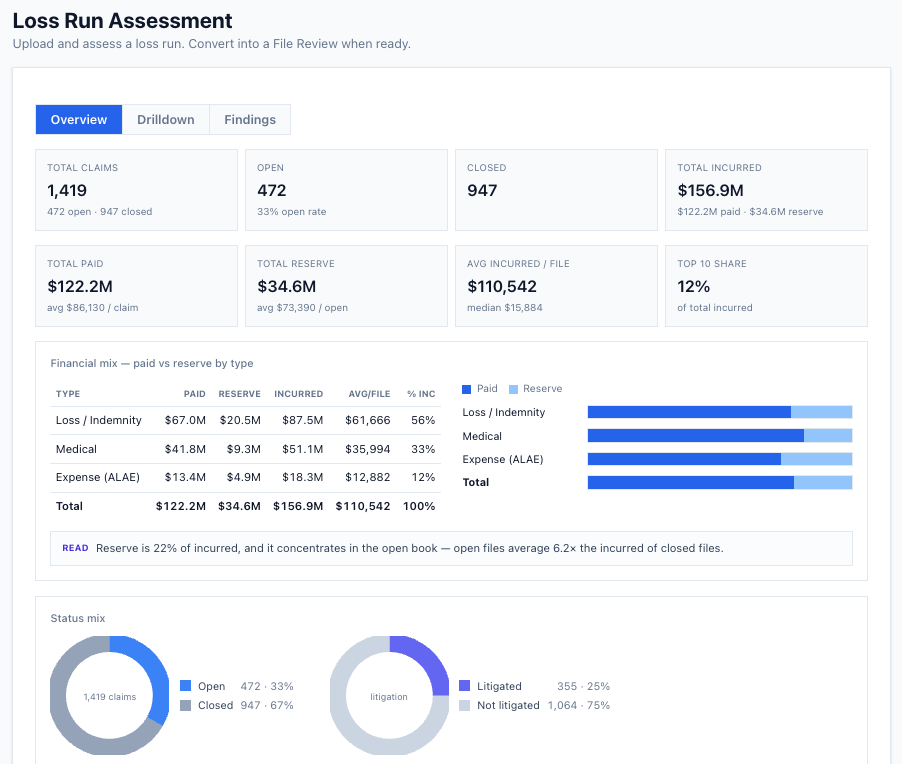
Know which files to audit before you open one.
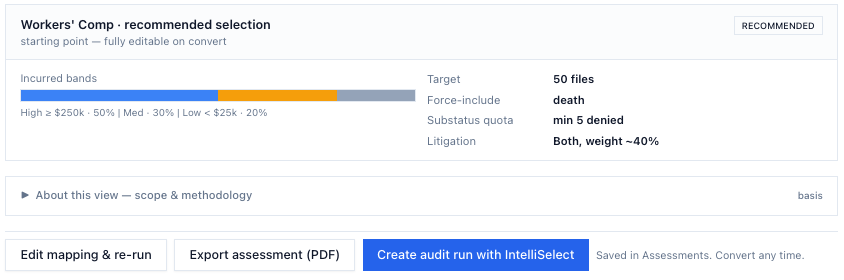
Upload a loss run in any column layout. The assessment profiles the whole book: status, paid, reserve and where the money concentrates. Intelligent selection then recommends the files worth reviewing, ready to convert into an audit run.
Reviewer-led
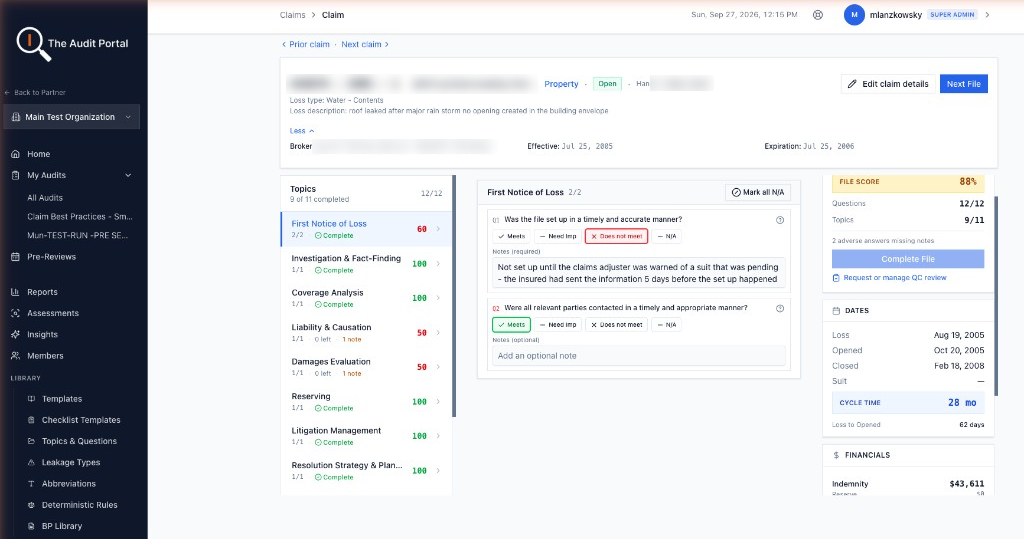
Your auditor leads. The platform keeps pace.
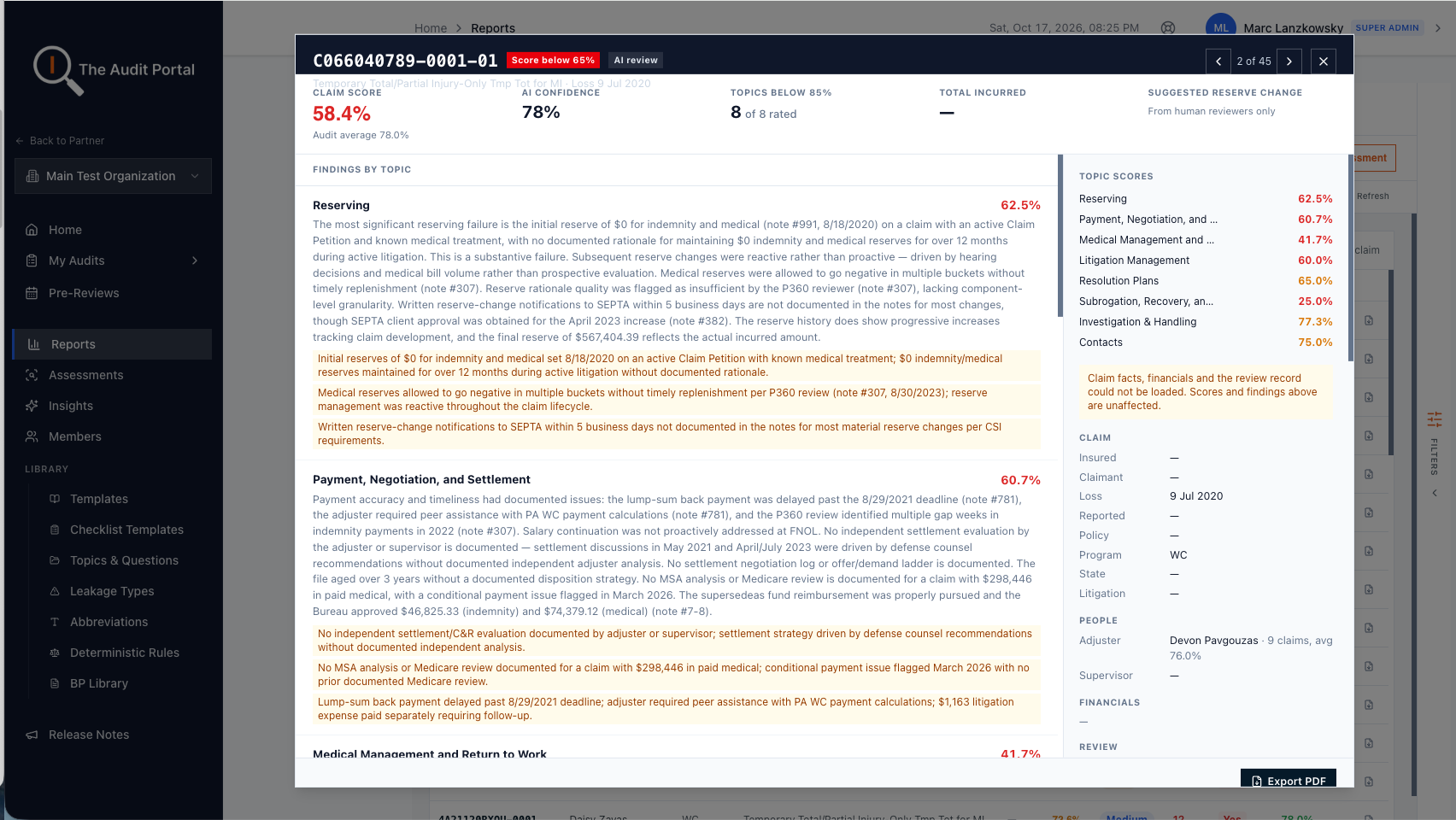
Claim notes, reserve history, dates and financials sit beside your framework questions. Determinations are recorded as they are made and compile into the report automatically.
AI-led
Every claim in the file, scored against your framework.
The pipeline applies the same topics, questions and criteria your reviewers use. Each topic is scored with its reasoning, the claim notes it relied on and the flags it raised. Output is advisory. A person makes the call.
Bordereaux triage
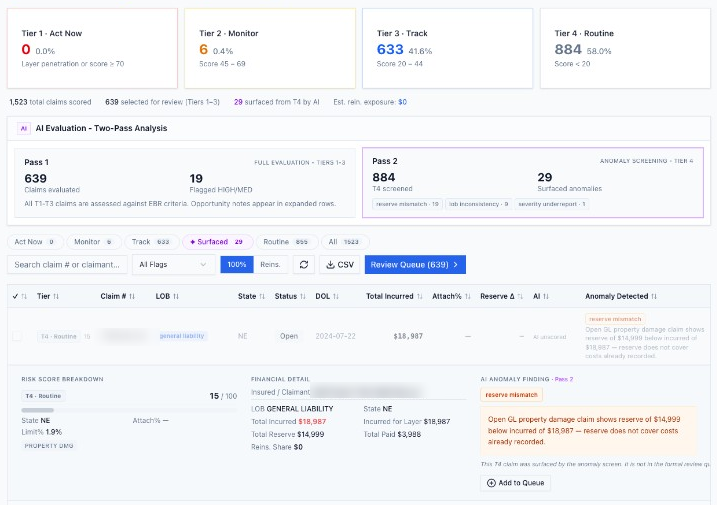
Every claim on the bordereau, ranked by exposure.
Each bordereau is scored and tiered into Act Now, Monitor, Track or Routine, with layer penetration and reinsurance share alongside. A two-pass AI evaluation reviews the top three tiers in full and screens Routine claims for anomalies like reserve mismatches, so nothing hides at the bottom.
From live audit to boardroom-ready report.
Whichever mode you run, the results feed the same dashboards, reports and insights.
- OverviewOverall score, claims reviewed, score bands and topic scores, updating as auditors work.
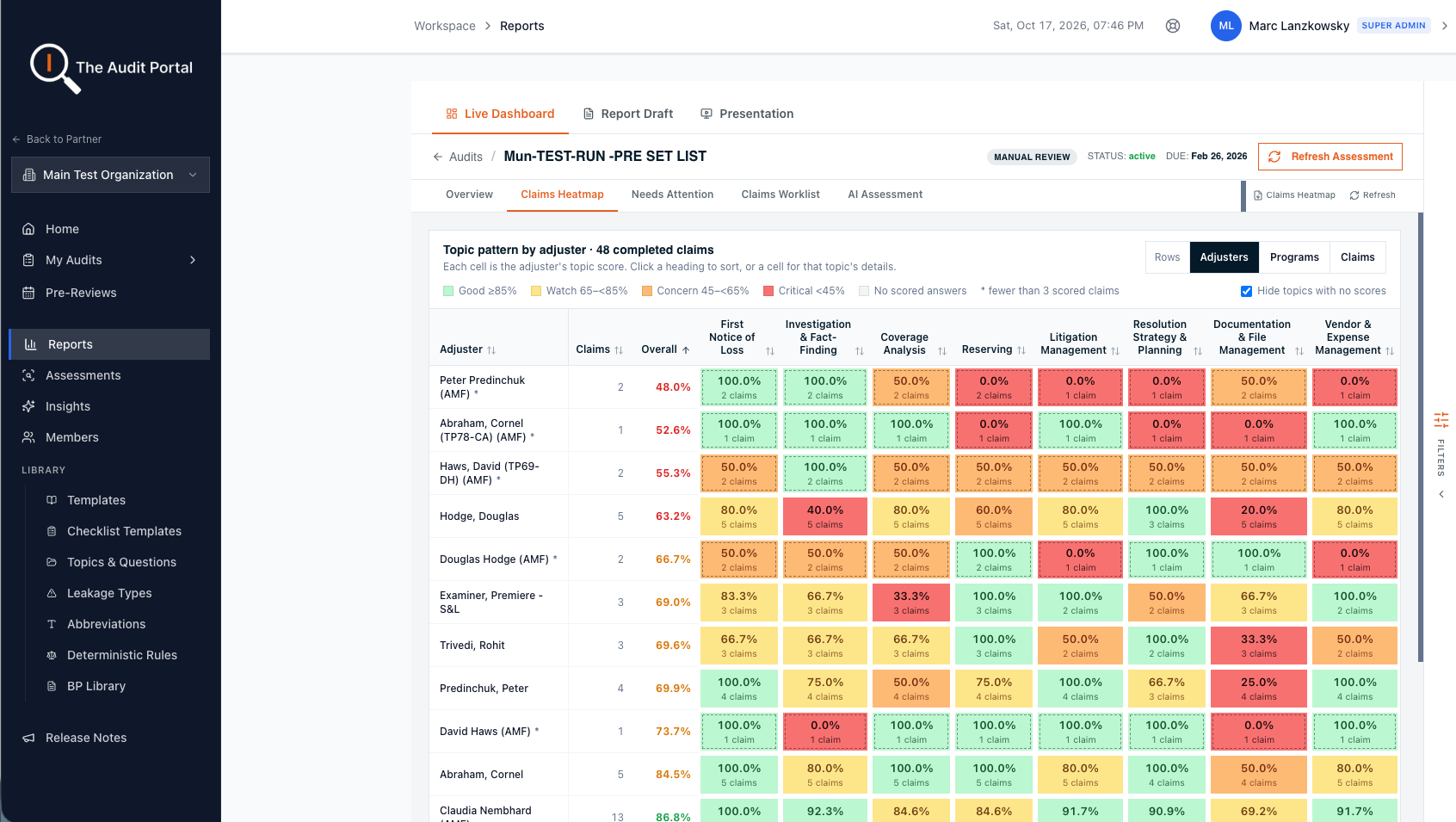
- HeatmapTopic scores by program, adjuster or claim, color-coded so weak areas stand out.
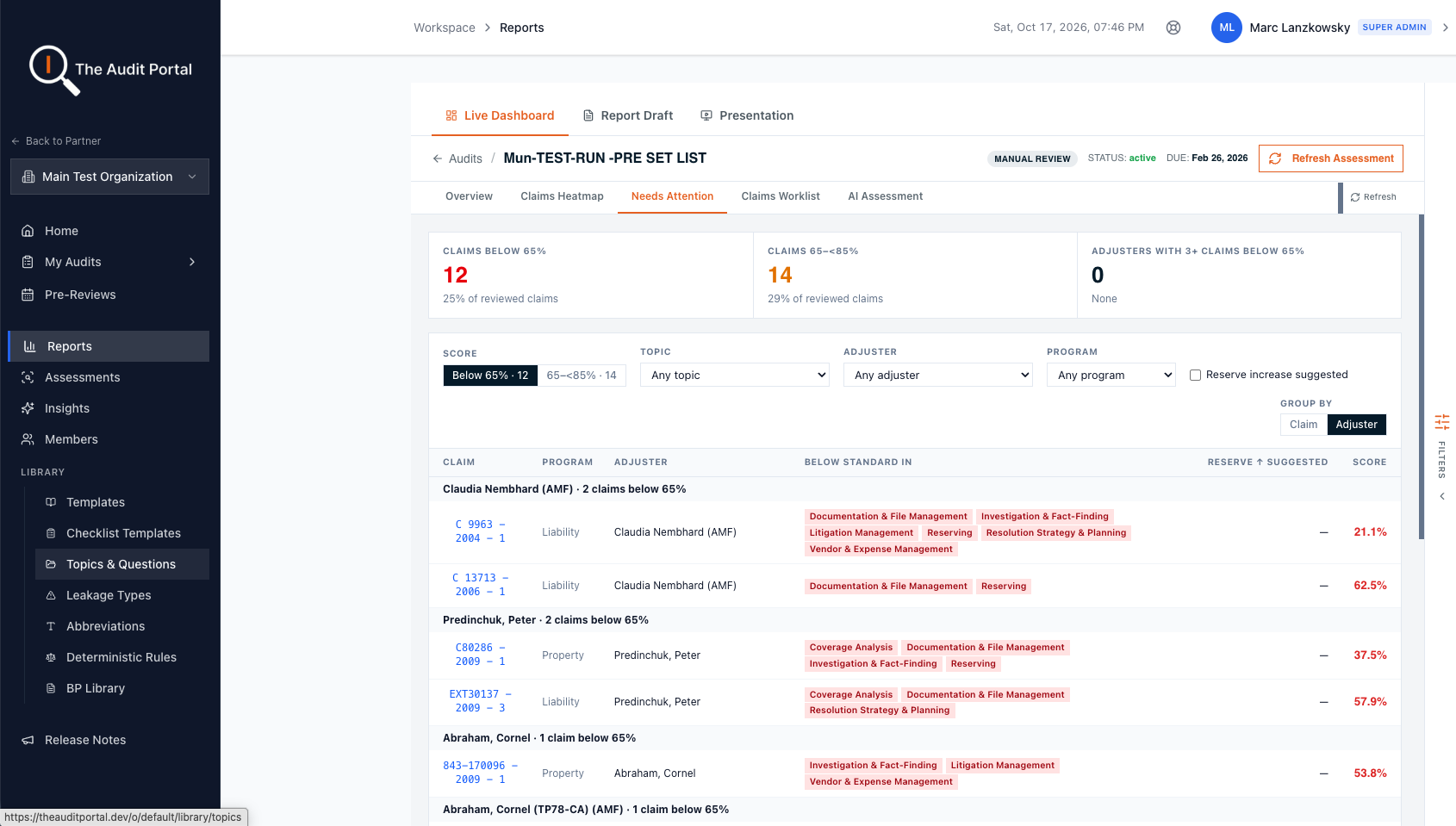
- Needs AttentionFiles below standard, grouped by adjuster, with the failing topics on each claim.
- WorklistThe files and open items still needing attention, in priority order.
- AI assessmentPatterns, risks and themes surfaced alongside the auditor’s scoring.
- AI draft audit reportA full first draft written from the findings. Days of writing become minutes, and the auditor keeps the final say.
- Executive summary and appendixA leadership summary up front, file-level detail behind it.
- Preview and PDF exportReview the finished report on screen, then export a branded PDF.
- Findings presentationA readout-ready presentation built from the same data as the report.
- Operational review reportAssessment and report for organization-level reviews, domain by domain.
- Insights dashboardTrends across every audit, not just one review.
- Ask InsightsPlain-English questions, answered from your own audit results.
- Cross-audit pattern analysisRecurring issues and systemic gaps across programs, TPAs and periods.
- Insights PDFA shareable report for leadership, boards and partners.
- Full-file screeningEvery claim checked against your criteria, not a sample. Hundreds of claims in about a minute.
- Anomaly screenOutliers and data irregularities flagged for follow-up.
- Code mappingCedant-specific codes interpreted, so every source is reviewed consistently.
- Flagged-claim findingsRisk level, confidence and the criteria each claim triggered.
Picks a representative, defensible set of files to audit.
Long note histories condensed for faster file review.
Checks auditor and AI scoring agree, so results stay reliable.
Regulatory updates tracked so criteria stay current.
An assistant for auditors.
Questions across one review or many, answered from your own audit data, with citations.
Deterministic rules, built into the review.
Some requirements aren’t a judgment call. Add a rule set and every selected claim is checked against it the same way, every time, alongside your framework, with the source text cited in the finding.
Same claim, same rules, same result.
Each finding quotes the rule it was checked against.
Only the rules that apply to the claim are checked.
Rule sets are maintained and validated by reviewers.
From findings to decisions.
Five-factor risk scoring places every claim in one of four tiers, with reserve recommendations attached where they are needed.
Material exposure or a handling failure. Escalate this cycle.
Adverse signals. Watch the next reserve movement or diary.
A pattern worth noting. Revisit at the next audit.
Handled to standard. No action.